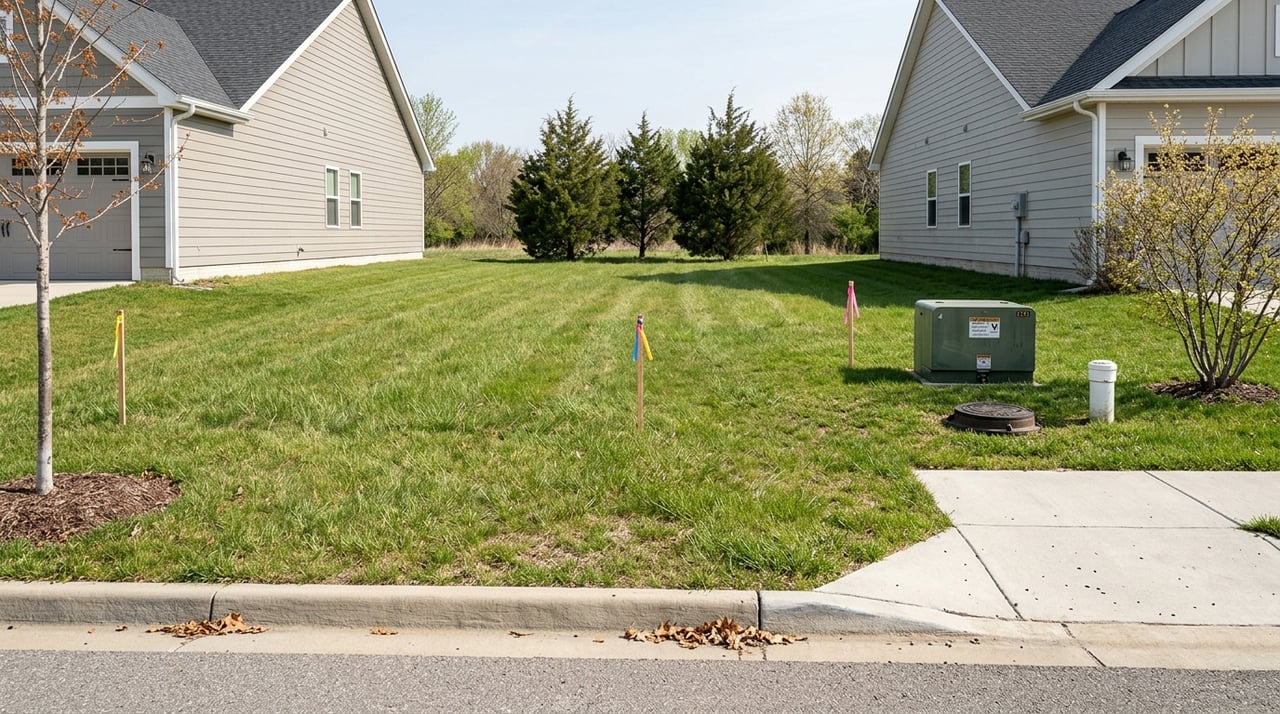
How to Buy Land in Freeburg IL Before You Build
April 2, 2026
April 2, 2026
Thinking about buying land in Freeburg? It can be an exciting move, but it is also one of those purchases where the details matter fast. A lot that looks perfect online may come with zoning limits, utility costs, septic questions, or floodplain issues that change your plans and your budget. This guide will help you understand what to check before you buy so you can move forward with more confidence. Let’s dive in.
Freeburg is a village of about 4,600 residents located roughly 24 miles southeast of St. Louis, which gives you a small-town setting with access to the larger metro area. According to the Village of Freeburg, the area includes a mix of in-town lots and more rural property options.
That mix matters because Freeburg is not a one-size-fits-all land market. The village’s comprehensive plan shows 378 undeveloped parcels totaling 1,889.68 acres, with 1,448.23 acres, or 76.64%, classified as unimproved rural farm land, based on the Freeburg Comprehensive Plan Update. In practical terms, you may be comparing a platted village lot, an edge-of-town homesite, and a larger rural tract that all come with very different rules and costs.
Before you think about house plans, confirm whether the property is inside Freeburg village limits or in unincorporated St. Clair County. That one detail affects which rules, permits, and review process apply to your purchase.
Inside village limits, Freeburg’s zoning code applies. Outside village limits, St. Clair County handles zoning, building permits, electrical permits, occupancy permits, inspections, code enforcement, and flood zone determinations, as outlined in the county zoning and permit information.
Freeburg also actively regulates development through its Planning and Zoning Board, zoning code, subdivision code, property maintenance code, and nuisance code. The village planning page makes it clear that parcel-by-parcel review is important before you commit to a contract, and that zoning administrator approval is required before new construction.
A lot can be available for sale and still not work for the home you want to build. That is why zoning should be one of your first checks, not something you save for later.
Freeburg’s residential-relevant zoning districts include A-1 Agricultural, SR-1 Single-Family Residence Large, SR-2 Single-Family Residence Small, and the O-FP flood plain overlay. The village keeps its official zoning map on file and online through the Freeburg zoning code.
Minimum lot standards vary quite a bit by district:
Those numbers are only the starting point. Setbacks, lot coverage, and parking requirements also vary by district, so a parcel that looks big enough may still be a poor fit for your intended home design.
Before you make an offer, ask:
In Freeburg, buildability is about more than size. The zoning code also regulates some materials, structure types, and residential uses.
For example, in SR-1, manufactured homes are prohibited unless a special-use permit is granted in limited circumstances. In SR-2, manufactured homes, duplexes, apartments, and similar uses are excluded. The code also prohibits primary metal residential building materials, allows high-rib metal roofing, and bans prefab metal buildings, pole barns, railroad cars, shipping containers, and similar temporary structures in residential districts.
If you already have a house style in mind, these details matter. They can affect whether the lot supports your vision without changes, added approvals, or a different building plan.
One of the biggest differences between a smooth land purchase and an expensive one is utility access. In Freeburg, that can vary a lot depending on whether the parcel is inside village limits or outside them.
Within village limits, Freeburg provides municipal electric, water, wastewater, and trash service. The village notes that it maintains its own municipal power generating plant and can generate 100% of its power needs, while the surrounding rural area is served by Ameren IP, according to the Freeburg utilities information.
For a residential build inside village limits, posted tap-on fees include:
These fees, plus deposits, must be paid with the building permit under the Freeburg building permit packet. The village also says meters are not turned on until fees and deposits are paid.
Even when utilities are available, connection costs may not be simple. The village states that standard overhead electric service includes the first 150 feet of wire and the meter, while standard underground service includes the first 100 feet. Additional length and line extensions are charged for labor and materials.
Water meter installation can also range from about $500 to $2,500 depending on bore requirements, pressure-reducing equipment, and tubing length and size. If service is not already at the property line, those extra costs can add up quickly.
Outside village limits, utility questions become even more important. The village states that water service outside village limits requires a pre-annexation agreement and costs $1,000 plus labor and materials for approved outside customers. Sewer connection outside village limits also requires a pre-annexation agreement and is posted at $1,500 per unit, according to the Freeburg water and wastewater information.
If you are buying land that is not served by public sewer, do not skip septic due diligence. In St. Clair County, the Health Department regulates private sewage systems and requires a permit before constructing or repairing one.
The department states that the system must be installed by a licensed contractor or homeowner, the application fee is $300, and subdivisions served by private sewage must be reviewed by the office, based on the St. Clair County Health Department private sewage page.
Soil testing matters too. The Illinois Extension septic soil evaluation guidance explains that soil evaluations can be more informative than a simple percolation test because they can reveal limiting layers such as seasonal high water tables, bedrock, and slow-permeability soils.
If the parcel needs a private well, St. Clair County also requires a permit for newly installed or renovated wells. The Health Department says wells must be built by an IDPH-licensed well driller, the permit fee is $200, and free water sampling is available for new and existing wells.
Flood risk is not something to assume based on the general area. It should be checked for the exact parcel you want to buy.
Freeburg posts FEMA letters and flood maps on its zoning and flood maps page, and the zoning code includes an O-FP flood plain overlay district. St. Clair County’s zoning department also provides flood zone determinations.
If a property includes low areas, creek edges, or irregular topography, it is smart to verify both flood status and how drainage could affect the homesite. This is especially important before finalizing your design, driveway placement, or septic layout.
A parcel can look attractive on paper but become complicated if access is limited or if you are hoping to divide it later. That is why road frontage and legal description checks belong in your due diligence process.
For buyers considering long-term flexibility, St. Clair County’s mapping office says parcel divisions generally require at least 5 acres and 50 feet of public road frontage, with specific exceptions, according to the county mapping division guidance.
If you want to confirm ownership records, subdivision plats, annexations, or recorded documents, the St. Clair County Recorder of Deeds is the official land-records office. County GIS and parcel tools can also help you review parcel, zoning, and boundary information before you move forward.
When you compare homesites in Freeburg, price alone does not tell the full story. Two parcels with similar acreage can have very different real-world value once you factor in buildability and development costs.
In general, the biggest value drivers are likely to be:
Because of that, buildable in-village lots often come with lower development risk than raw land outside village limits. Municipal utilities can reduce the number of unknowns, while rural parcels may require wells, septic design, pre-annexation agreements, or frontage and division review.
For pricing context, the St. Clair County Assessor notes that its office can help people compare sales and that real property is reassessed on a quadrennial basis. For a specific homesite, recent comparable sales, utility status, and recorded restrictions are usually more useful than broad regional averages.
If you want to reduce surprises, use a checklist before you write an offer or before your due diligence period ends.
Buying land or a homesite in Freeburg can be a great opportunity, but the best purchase is usually the one that matches your build plans, your timeline, and your budget for site work. The key is to look beyond acreage and price and focus on what the parcel actually allows, what it will take to develop, and which local approvals come next.
If you are weighing village lots against rural acreage, local guidance can help you compare options more clearly and avoid expensive surprises. When you are ready to talk through homesites, land listings, or the pros and cons of a specific parcel in Freeburg, connect with Jessica Michalke for personalized, neighborhood-focused guidance.
July 9, 2026
July 2, 2026

Buy | Sell | Thrive at Home
July 1, 2026
#4 is our favorite!
June 25, 2026
June 18, 2026
June 11, 2026
June 4, 2026

Buy | Sell | Thrive at Home
June 1, 2026
Because summer is a great time to start
May 28, 2026
May 21, 2026
May 14, 2026
May 7, 2026

Buy | Sell | Thrive at Home
May 1, 2026
Smart prep now = more sunshine later
April 23, 2026
April 16, 2026
April 2, 2026

Buy | Sell | Thrive at Home
April 1, 2026
Smart prep now = more sunshine later
March 24, 2026
March 5, 2026

Buy | Sell | Thrive at Home
February 27, 2026
3 Smart Ways to Keep Your Home Ready, So You Can Make Moves on Your Terms
February 19, 2026
February 5, 2026
February 2, 2026
Friendly, trusted guidance for military families relocating to the Scott AFB area

Buy | Sell | Thrive at Home
February 1, 2026
3 Major Benefits of Homeownership That Go Beyond the Numbers

January 15, 2026
Thrive in Real Estate
January 15, 2026
January 1, 2026

Buy | Sell | Thrive at Home
December 23, 2025
Approach Your 2026 Real Estate Decisions with Confidence
December 18, 2025
December 4, 2025
November 21, 2025
November 6, 2025
October 16, 2025
Real Estate
October 9, 2025
Discover the Best Mortgage Solutions in O'Fallon

September 30, 2025
Live.Laugh.Empower.
August 25, 2025
Live. Laugh. Empower
July 22, 2025
Homeownership Education
Home Ownership Education
June 19, 2025
Homeownership Education

May 27, 2025
April 22, 2025
Real Estate Expertise, Thrive At Home, Buyers & Sellers

April 22, 2025
Live.Laugh. Real Estate

March 26, 2025
Thrive At Home

March 13, 2025
LIVE. LAUGH. ILLINOIS.
March 3, 2025
Homeownership Live.Laugh. Real Estate February 6, 2025
January 23, 2025
Looking to Buy & Sell?: Know Your Options!
Jessica Michalke | December 4, 2024
How will you thrive in 2025?
We invite you to join us in this exciting new era of real estate. Experience the difference of working with a brokerage dedicated to empowering our agents, serving clients, and giving back to the community. Together, we can build a better future for our communities, and we'd love for you to be a part of it.
Join our community of enthusiastic subscribers and receive two emails per month packed with insights to help you live well, laugh often, and love Shiloh & Illinois even more!
(314) 221-1608
[email protected]
1207 Thouvenot Ln
Shiloh IL 62269